

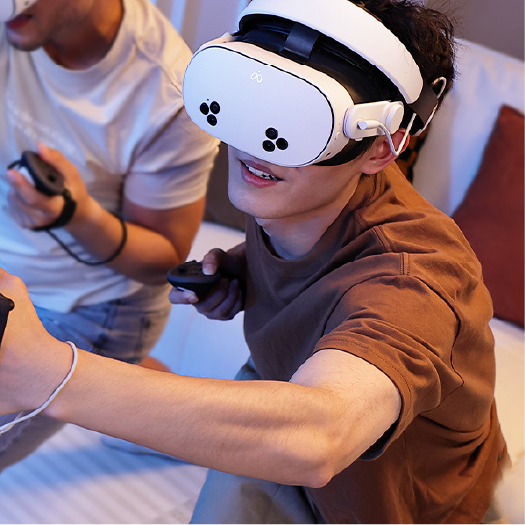

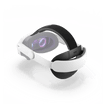
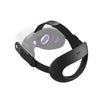
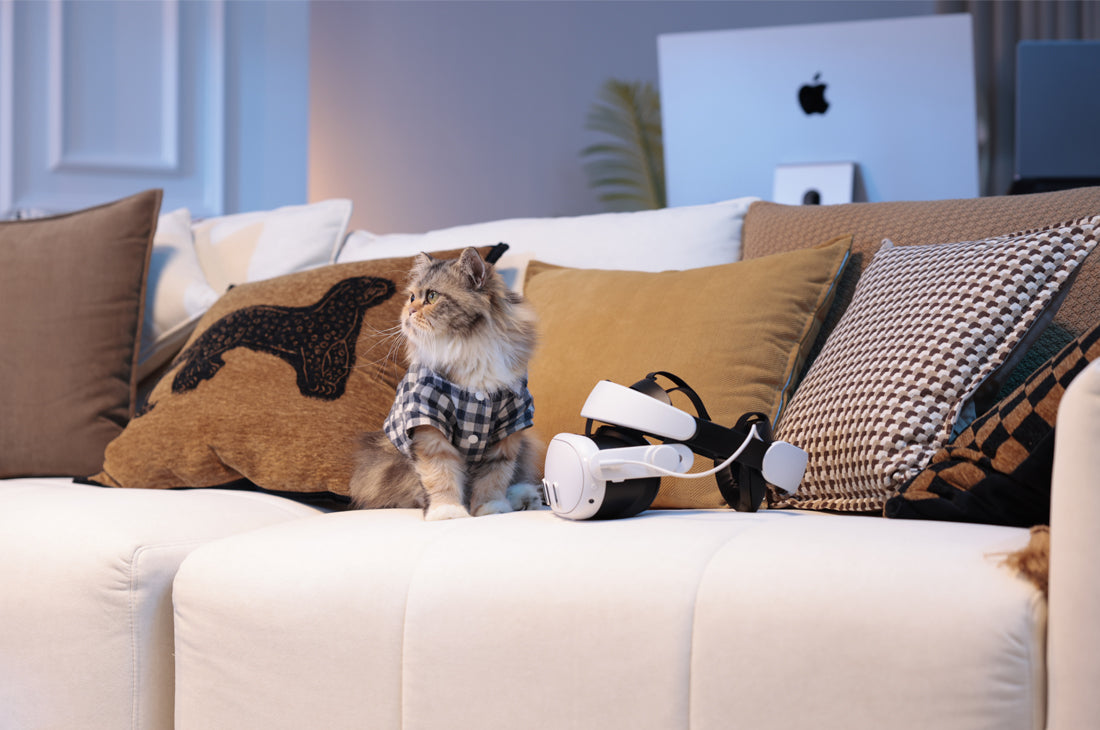
P5000 is a removable USB Power Delivery system built around two compact power banks. Each pack is rated at 5,000 mAh and 105 g, and the included hook-and-loop attachment places one pack on a VR head strap while the second remains available for the next manual change. Meta Quest 3 and Quest 3S are the main application examples in this guide, but they are not the compatibility boundary. P5000 works with all VR headsets that support USB Power Delivery (PD) and other compatible USB-C electronic devices.
P5000 specifications at a glance
| Product data | P5000 specification |
|---|---|
| Protocol | USB Power Delivery (PD) |
| Compatibility | All VR headsets that support USB Power Delivery (PD) and other compatible USB-C electronic devices |
| Application focus in this guide | Meta Quest 3 and Meta Quest 3S |
| Package format | Two removable power banks |
| Capacity | 5,000 mAh per power bank |
| Weight | 105 g per power bank |
| Connector | USB-C |
| Attachment | Included hook-and-loop attachment for a VR head strap |
| Changeover | Manual pack change; one pack is used at a time |
| Integrated into the head strap | No |
These specifications describe the product without converting capacity into a fixed runtime or USB PD into a fixed charging wattage. Runtime changes with the powered device and workload, while the exact power exchanged over USB PD depends on the compatible source, device and connection.
How P5000 differs from a battery strap
P5000 keeps the external battery separate from the head-support structure. A battery strap combines those two functions into one assembly, so its battery remains attached whenever that strap is worn. P5000 instead uses a removable pack secured with hook-and-loop, allowing the power module to be added for a longer session and removed when it is not needed.
The separation also changes the charging workflow. An integrated battery strap is recharged as one installed accessory. P5000 provides two independent packs for a manual rotation. One pack supplies external power while the other can remain ready for the next change or be returned to charging after use.
| Power format | Battery position | Head support | Changeover | Main structural tradeoff | |---|---|---|---| | Planned charging break | No external pack while the device is in use | Unchanged | The session pauses for charging | No added worn hardware, but no external power during the session | | Battery strap | Fixed within the strap assembly | Replaced together with the original strap | The full assembly is recharged | One integrated unit, with battery weight always attached | | P5000 removable two-pack | One removable 105 g pack at a time | Remains independent from the battery | Manual pack rotation | Separate attachment, USB-C connection and charging routine |
The comparison is structural rather than a ranking. P5000's defining advantage is modularity: it adds a power pack without requiring the power source to become a permanent part of the head strap.
A removable pack keeps the setup modular
A removable pack supports different power configurations with the same device. The headset can be used without the pack for a shorter session, then used with one P5000 pack when external power is needed. The second pack does not have to be worn at the same time, so the two-pack increases the available rotation without placing both battery units on the headset.
The hook-and-loop attachment also keeps P5000 independent from a particular head-support design. On a VR setup, it secures the active pack to an appropriate area of the head strap. On other compatible USB-C electronics, the same PD power bank can be used as a portable source without treating a headset model name as the compatibility rule.
This modular format introduces separate parts that an integrated battery strap does not have. The active pack, attachment and USB-C connection must remain arranged as one secure setup during use. The second pack also needs a consistent storage and charging routine so it is ready for the next manual change.
The two-pack supports a manual rotation
P5000 includes two removable power banks rather than one permanently installed battery. The normal workflow uses one pack at a time:
- Prepare both P5000 packs according to the product charging instructions.
- Secure one pack with the hook-and-loop attachment and connect it through USB-C.
- Keep the second pack ready away from the active attachment.
- When the active external pack is depleted, disconnect it and remove it from the attachment.
- Secure the second pack, reconnect the USB-C path and return the used pack to charging.
The changeover is manual. External power is interrupted while the packs are exchanged, and the powered device continues only according to its remaining internal battery. P5000 therefore supports a repeatable rotation, not automatic hot swapping, uninterrupted operation or unlimited runtime.
In a shared-device environment, labeling the two packs A and B makes the rotation easier to track. The active pack, waiting pack and used pack each have a clear state, which reduces uncertainty about which unit is ready for the next session.
What 5,000 mAh per pack means
Each P5000 power bank is rated at 5,000 mAh. That is the capacity specification for an individual pack. Because the packs are used one at a time and power is converted before reaching the connected device, the two-pack should not be described as delivering 10,000 mAh directly to a headset or other electronic device.
Capacity is also not a fixed runtime statement. Device power demand changes with the application, display and audio settings, wireless activity, background features, firmware, battery condition and other operating conditions. A PD-capable VR headset and a compatible USB-C camera can therefore produce different operating times from the same P5000 pack.
The fixed product statement is 5,000 mAh per pack. No universal number of additional hours is attached to that specification in this article.
What 105 g per pack means
Each individual P5000 pack weighs 105 g. Only one pack is placed in the active setup, while the second remains separate. This is different from mounting the capacity of both packs on the headset at once.
The 105 g specification describes the power bank itself. A complete VR setup also includes the head strap, hook-and-loop attachment and USB-C connection. Their arrangement affects total worn mass and placement, so the pack weight should not be presented as the weight of the entire installed system.
Weight alone does not prove a comfort, balance or health outcome. P5000's verified structural point is that the active battery remains removable and that only one 105 g pack is used at a time.
USB Power Delivery defines compatibility
P5000 uses USB Power Delivery. Its compatibility is therefore defined by the receiving device's support for PD and a compatible USB-C connection, not by a closed list of headset model names.
This includes all VR headsets that support USB Power Delivery (PD) and other compatible USB-C electronic devices. Meta Quest 3 and Quest 3S are featured here because they are relevant applications for the article's search intent, not because P5000 is limited to those two devices.
Protocol compatibility does not create a fixed charging-speed claim. USB PD devices exchange supported power capabilities, and the actual result depends on the connected PD device and USB-C path. P5000 is not assigned one universal charging wattage in this article.
Devices that do not support USB Power Delivery, or that do not have a compatible USB-C power path, fall outside this compatibility statement. A USB-C-shaped connector by itself is not the compatibility standard; PD support is.
Quest 3 and Quest 3S as application examples
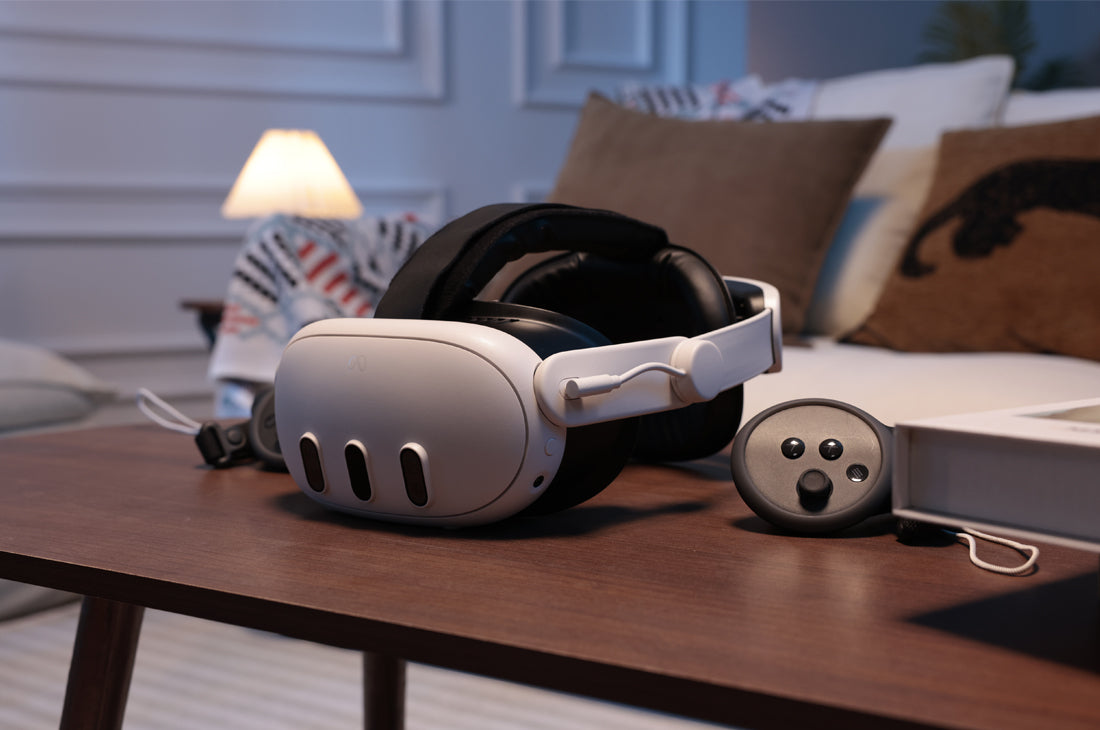
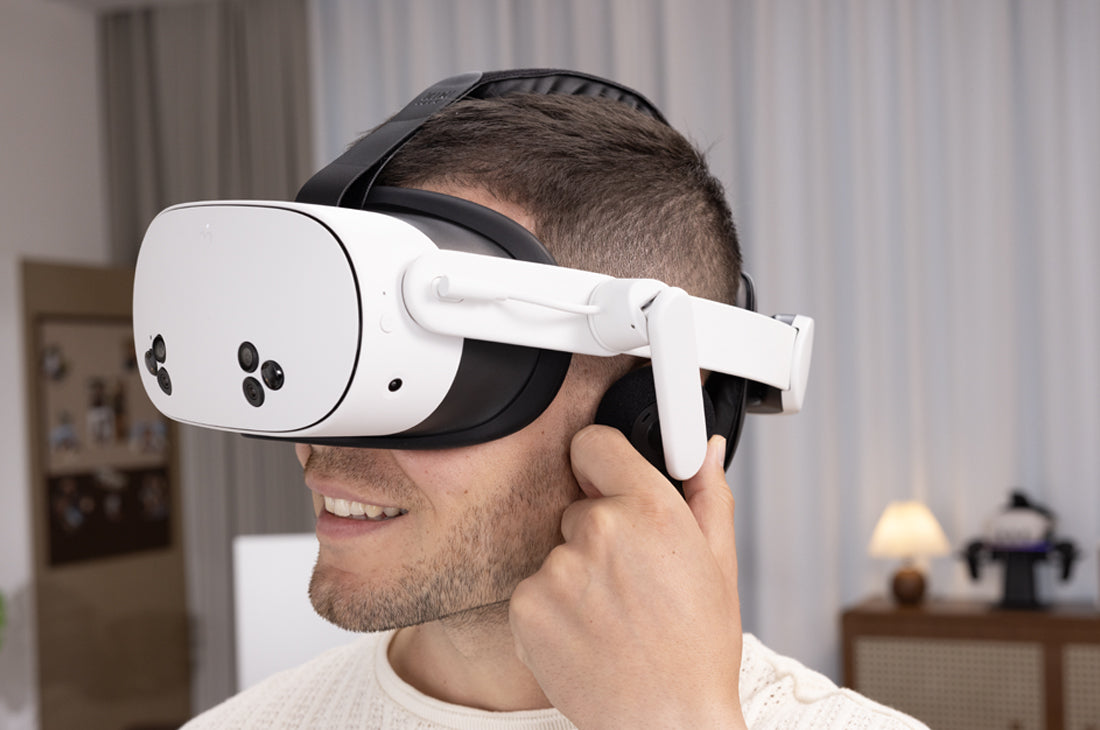
On Meta Quest 3 and Quest 3S, P5000 provides a removable alternative to an integrated battery strap. The hook-and-loop attachment places one pack on the VR head strap, while the USB-C power path connects the active pack to the headset. The original head-support structure remains separate from the power bank.
For a shorter session, the headset can be used without the external pack. For a longer or shared session, one P5000 pack can be added and the second reserved for the next manual change. This creates a variable setup without requiring both packs to be carried on the headset.
The same protocol rule applies beyond these examples. A different VR headset is compatible when it supports USB Power Delivery and has a compatible USB-C connection. A compatible non-VR USB-C electronic device can use the P5000 pack under the same PD-based principle.
Attachment and cable arrangement
The hook-and-loop attachment is the wearable part of the P5000 VR setup. It holds the active pack on the head strap while keeping the pack removable. The mounting area remains clear of strap adjustment controls, and the active pack remains secure during normal head movement.
The USB-C path runs from the active P5000 pack to the powered device. On a headset, the connection is arranged with enough slack to avoid pulling sideways on the port, without leaving a loose loop that can catch during use. The cable route remains part of the installed system even though the battery itself is removable.
This arrangement is different from the P5000 compatibility rule. The hook-and-loop attachment governs how the pack is worn on a VR strap; USB Power Delivery governs which VR headsets and USB-C electronic devices can receive power from it.
Where the P5000 format is useful
P5000 is built for situations where removable external power is more useful than a battery permanently integrated into a head strap. The two-pack format supports variable session lengths, shared devices, demonstrations and other workflows where one active pack and one waiting pack are easier to manage than one fixed battery assembly.
It also extends beyond VR. The same 5,000 mAh, 105 g P5000 pack can supply other compatible USB-C electronic devices that support the required PD connection. This makes the protocol and the device's compatible power path more important than the product category printed on the device.
P5000 remains a manual, cable-connected system. It does not remove the need to arrange the attachment, USB-C path and charging rotation, and it does not promise a fixed runtime, fixed wattage or uninterrupted changeover.
P5000 in one view
The P5000 Compact Power Bank 2-Pack for Meta Quest provides two removable USB Power Delivery packs. Each pack is rated at 5,000 mAh and 105 g. The included hook-and-loop attachment supports a wearable VR setup, one pack is used at a time, and changeover remains manual.
Quest 3 and Quest 3S are the featured use cases in this guide. Compatibility itself extends to all VR headsets that support USB Power Delivery (PD) and other compatible USB-C electronic devices. That protocol-based scope, removable format and two-pack rotation are the defining differences between P5000 and a headset-specific integrated battery strap.

Laisser un commentaire
Tous les commentaires sont modérés avant d'être publiés.
Ce site est protégé par hCaptcha, et la Politique de confidentialité et les Conditions de service de hCaptcha s’appliquent.